Posts

Showing posts with the label BMW

BMW Z8 -- the BMW 507 Reimagined

Image
The BMW 507 produced 1956-1959 is widely considered a design classic, especially in the context of its time.  Its Wikipedia entry is here .  It was styled by Albrecht Graf von Schlitz genannt von Goertz von Wrisberg, or in shorter, English terms, Count Albrecht von Goertz (1914-2006) -- Wikipedia entry here . Wikipedia notes that it was hoped that the 507 would sell well, but in fact only 252 were ever built. About 40 years later a Chris Bangle design team (Henrik Fisker in charge of the exterior) did what Wikipedia ( here ) calls a "styling exercise intended to evoke and celebrate" the 507.  A show car followed  in 1997 and production began in 2000, continuing into 2003.  Total produced was 5703. Below are comparative images of the 507 and Z8. Gallery 1959 BMW 507, Bonhams auction photo.  Its styling theme is typical 1950s sports car: Flowing fenderline with upkick at the rear, hood lower than the front fenders but with a higher cowl.  The c...

BMW 328s -- Then, and More Recently

Image
BMW built 328-series sports cars and successful racing cars in the late 1930s, as t his Wikipedia entry mentions.  I wrote about some of those cars along with more recent concept versions here . The original 328 was simply a model sequence number.  In the mid-1970s BMW initiated its 3, 5 and 7 Series numbers (more were added later).  The 3 Series included the number 328i starting in model year 1995, based on its six-cylinder motor's displacement.  328i's were produced from 1995 to 2000 and from 2007 to 2015. This post presents a few 1930s examples along with some of the later cars.  Nothing profound here ... I simply thought it would be an interesting juxtaposition. Gallery 1936 BMW 328 Roadster, Car Magazine image An early 328.  No bumpers, tall windshield and leather hood straps. 1937 BMW 328 Mille Miglia "Büegelfalte" - RM Sothebey's auction image I wonder if Bill Lyons might have used this as partial inspiration for his Jaguar XK120 design. 1948 Jag...

Mini's Vision Urbanaut could be better home from home

Image
Here's an imaginary view of a future variant on the BMW Mini, with the name Vision Urbanaut, writes Brian Byrne . The company says its designers worked 'from the inside out' to create a space where -- in effusive designer language -- 'the car becomes a kind of retreat, a haven where you can relax ... or work with full concentration ... during a journey'. Well, astronauts and cosmonauts were once in the realm of science fiction too, so there's no reason to dismiss the ideas. Developed digitally, the concept includes, of course, some automated driving, electric motor, one sliding door for all ins and outs, and a four-seat format that allows for lounge as well as transportation use. There's much hype and hope in the blurb accompanying the release, and an impression that the car can be a true home from home, maybe even better than home. Not sure about the raisable windscreen, though ... albeit this is apparently about allowing the occupants to 'mingle'...

Styling a New Luxury Brand: Infiniti

Image
I wrote here about the 1990 Lexus, a successful new luxury brand.  In this post, the subject is Infiniti, another new Japanese luxury brand launched around the same time.  Specifically, the model Q45 (marketed model years 1990-96). Its Wikipedia entry is here . As mentioned in the earlier post, stylists and management surely paid attention to potential competitors.  Below are cars in the American market that were in production during the time Q45 styling was developed.  They were selected on the basis of having wheelbases fairly similar to that of the new Infiniti.  Their designs are compared to that of the Q45. Most of the images below are factory-sourced photos. Gallery 1985 Cadillac Sedan DeVille Basically 1970s-'80s "three box" angular styling featuring large glass areas.  The main concession to aerodynamic efficiency is the slanted windshield. 1981 Lincoln Town Car This model remained in production during the 1980s.  Its design is even more ...

Styling a New Luxury Car Brand: Lexus

Image
So you want to launch a totally new luxury car brand.  One detail to be decided is the car's styling.  And surely Toyota stylists and management glanced at designs of the new car's intended or possible competition.  How different or similar should it look? The Lexus (Wikipedia entry here ) was launched in the USA for the 1990 model year and was a great success that has continued since. The subject of this post is Lexus styling compared to some potential competitors in production while it was gestating.  Perhaps other brands were evaluated in addition to the set shown below, but those pictured were surly among those studied.  They tend to have similar wheelbases to that of the 1990 Lexus LS 400 (2814 mm, 110.8 inches). Gallery 1985 Cadillac Sedan DeVille Since the US market was key to Lexus market planning, Cadillacs were evaluated.  The current Caddy in the Lexus size range was the Sedan DeVille that appeared for the 1985 model year.  Its styling conti...

Redesigned BMW 4 Series Coupé

Image
The redesigned BMW 4 Series Coupé (Wikipedia entry here ) is a few months from appearing in showrooms as I draft this post (July), but photos are available on the Internet. Those images are of a car painted white, which means that subtle areas of body sculpting can't be seen clearly.  Nevertheless, I'm writing about the new 4 Series because of its grille design, a new variation on BMW's traditional two-element "nostrils" format.  Each element is seven-sided with angles softened slightly by sharp-radius curves.  Also, the size of the assembly is large. Those two features -- rather geometric outlines and large size seem to be a new styling direction for BMW.  For example, the new 7 Series sedan has a large grille ensemble and the the concept version of the 4 Series as well as the Concept i4 electric car have large, angular grille shapes. The images below juxtapose the previous 4 Series with the 2021 version. Gallery Previous 4 Series Coupé.  Generally a nice desig...

New BMW M3 and M4 iterations revealed

Image
These are the latest BMW M3 and M4 models, with deliveries in RHD markets next March and upping the iconic performance cars' game, writes Brian Byrne . The cars will have the option of all-wheel drive in a similar system to that introduced in the M5 xDrive. It is rear-biased, and also allows the selection of RWD. An 8-speed automatic replaces the predecessor vehicles' 7-speed dual-clutch, and a 6-speed manual will be available. Power output ranges from 473hp-503hp, with 100km/h sprint capability of 4.1s and 3.8s respectively. An M3 Touring wagon and M4 Convertible will be offered later.  

BMW Convertibles Since 2001

Image
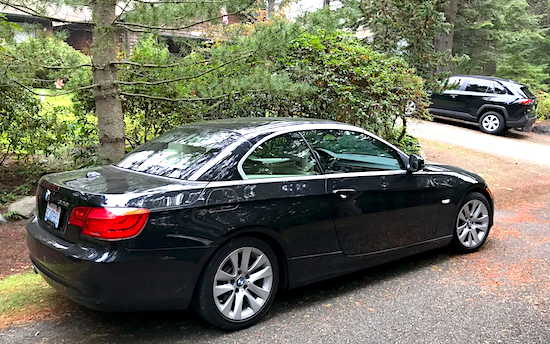
I seldom write about convertibles because passenger compartment greenhouses require plenty of styling effort that's not required for convertibles.  However, I am now inspired to write about some BMW convertibles because my fiancée recently bought the 2013 328i convertible shown in the photo above (that's my '19 Toyota RAV4 in the background). Hers is a retractible hardtop model that requires a good deal of space in the trunk area.  The following image of a 2014 BMW 4 Series Convertible retraction stage might offer an idea as to what goes on and why aft ends of BMW convertibles are shaped the way they are. The images below of various BMW convertibles starting with the 2001 model year are side views intended to show the top storage areas in profile for comparison.  All images are factory-sourced photos.   Some cars shown have retractible hardtops, others are conventional soft top convertibles. Gallery 2001 BMW M3 Convertible All the cars shown here have a high, nearly...