Posts

Showing posts with the label Stylists

What Were They Thinking? Michelotti's Vignale Rolls Royce
Image
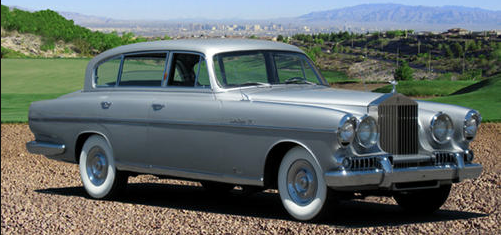
"The Ugliest Roll Royce Ever?" -- That was the title of a 2001 piece on Motor Trend magazine's web page.  Well, maybe.  But there might have been a few that were worse. The cited car was a 1954 Roll-Royce Silver Wraith with a custom body by Italian coachbuilder Vignale completed in 1955.  The designer was the well-known Giovanni Michelotti who later designed production car bodies for Triumph. Being a custom bodied automobile, its design features were influenced by Vignale's client.  Some of this is mentioned here on the Bonhams auction web site in reference to its 2014 offering at Quail Lodge in California.  What might be important is that he was an American.  Which suggests that he wanted the car to have 1954-vintage American styling features. Gallery The car was on display for a while at the Blackhawk museum in California's Bay Area.  That is the source of this and similar images below.  The "ugly" bit is the front end design that features t...

About the Sides on 1970 1/2 Camaros and Firebirds

Image
Michael Lamm, founding editor of the late, lamented "Special-Interest Autos" magazine wrote " The Fabulous Firebird ," a book about Pontiac's variation of the Chevrolet Camaro -- Firebird's Wikipedia entry is  here .  The following background is based on Lamm's book. Back in the late 1960s General Motors was prosperous and able to indulge the heads of the styling units responsible for the second-generation Camaros and Firebirds that appeared well into the 1970 model year.  The Camaro head stylist was Henry Haga, who I wrote about here in regard to his Art Center School days.  Firebird styling was initiated  by Jack Humbert and carried out by Bill Porter. Camaros were given a more crisp appearance, whereas Firebirds were a bit softer, more rounded.  One result was disagreement over the placement and form of the character lines along the cars' sides.  Rather than forcing one concept to prevail over the other, GM management allowed both variations to ...

Giugiaro Improves the Porsche 914

Image
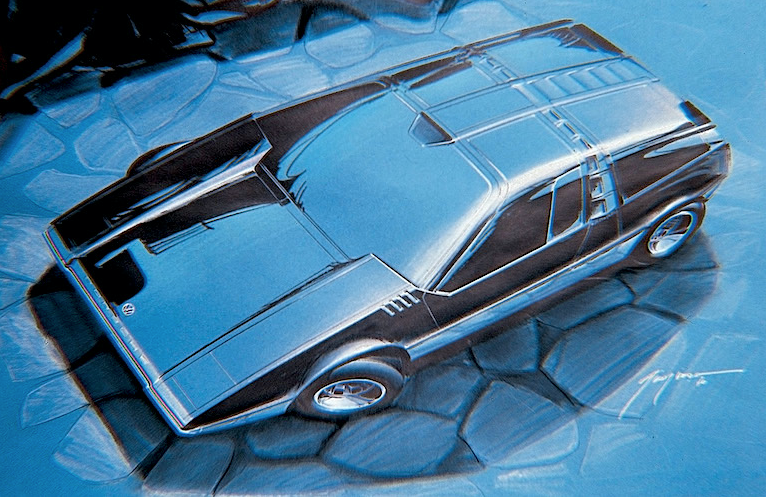
The upper image is a 1970 drawing of the Porsche Tapiro concept car by its designer, the famed Giorgetto Giugiaro .  Its Wikipedia entry is here , and I wrote about it here .  The lower photo is one I took of my 1971 Porsche 914 that I wrote about here .  I wrote about the 914 design itself  here .  The Wikipedia entry for the Porsche 914 is here . The Tapiro was derived from the Porsche 914/6, the six cylinder Porsche-engined version of the 914 that otherwise was powered by a four-cylinder Volkswagen motor.  The designs are strikingly different, so I thought readers might be interested in seeing them compared.  Click on the images to enlarge. Gallery Side view of a Porsche 914/6, Mecum auction photo. Side view of the Tapiro. Diagram showing ket interior layout features and dimensions.  Wheelbase lengths are identical, but the overall length of the Tapiro is 4060 mm whereas the 914's is 3985.  The major difference is height, the 914 measuring...

Raymond Loewy's First Hupmobile Design

Image
The 1932 Hupmobile (corporate Wikipedia entry here ) was an early project by pioneer industrial designer Raymond Loewy , and his first production automobile design.  I wrote about his Hupmobile work in general here . The present post features his 1932 design that was used on Hupp's more expensive line of cars.  According to the Wikipedia entry, by the late 1920s the company added models intended for what amounted to the upper-middle market segment and promoted them accordingly.  This was at the price of moving away from the clientele base that built the brand.  That resulted in diminished sales, a condition exaggerated by the Great Depression of the 1930s. For the 1932 model year Hupp marketed both the Loewy design and, for its lower price range, continuation of its previous design.  Examples of both are shown below.  Aside from photos taken when the cars were new, images are sourced for cars up for sale or auction. Gallery 1932 Hupmobile 216 Coupe This low...

Gerald Palmer's Riley Pathfinder + Wolseley 6/90

Image
Gerald Palmer (1911-1999) was one of the most important post- World War 2 British automobile designers (Wikipedia entry here ).  He was responsible for the Jowett Javelin that I wrote about here . He later moved to the Morris group where he designed the subjects of this post, the Riley Pathfinder , produced 1953-1957 (5,536 units built) and the Wolseley 6/90 produced 1954-1959 (11,852 units). The bodies were nearly identical aside from their grilles.  But the Riley was powered by a four cylinder motor whereas the Wolseley's engine had six cylinders, so this might be considered a marginal case of badge engineering. The images below are factory sourced or are of cars listed for sale. Gallery A 1955 Riley Pathfinder in this and the following two images.  At its 1952 origin, the styling was dated by American standards, but modern in its British context.  Aside from the prewar-style grille, the design features nothing but postwar elements, albeit in simple, conservative ...