Posts

Showing posts with the label Chevrolet

1990 General Motors W-Body Sedans

Image
By 1990 General Motors was on its path from industry dominance to bankruptcy.  Ford's aerodynamically influenced 1986 Taurus was a marketing success that required a response from GM.  That response was in the form of its new W Platform .  Coupes appeared for the 1988 model year, sedans following for 1990. The present post deals with the sedans.  These were the Chevrolet Lumina , Pontiac Grand Prix , Oldsmobile Cutlass Supreme and Buick Regal . Shamed by the lookalike 1982 A Body line, GM made an effort to have W Body cars for each brand look distinctive.  Some details are discussed below. Gallery Chevrolet Lumina Euro I owned one of these during my time as demographic forecast supplier to GM.  The basic Lumina had a different grille and no trunk lid spoiler. Pontiac Grand Prix This car had a slightly higher beltline and six-window passenger greenhouse.  Rear door cutlines differ. Oldsmobile Cutlass Supreme The basic body here is similar to the Lumin...

1988 Cadillac Voyage Concept

Image
One of General Motors' most interesting concept cars from around 1990 was the 1988 Cadillac Voyage (background here ). Unlike some concepts, this wasn't a motorless "pushmobile."  It even appeared in the 1993 Sylvester Stallone movie " Domolition Man ." The Voyage's design was wind tunnel tested, though GM stylists used enough straight-edge and angular detailing to avoid the overly-rounded appearance seen on recent Fords.  As shown below, some of the styling spirit of the Voyage found its way onto later GM production cars.  The Voyage images are from GM. Gallery Front quarter view.  Being a concept car, it has small bumpers.  Windows are large, a carryover from 1970-80 "three-box" design practice.  Note the cutline above the front wheel opening.  According to the first link above, that panel pivoted when the wheel turning angle was large enough, thus fixing (with some complexity) a problem with designs such as 1950-vintage Nashes featuring skir...

About the Sides on 1970 1/2 Camaros and Firebirds

Image
Michael Lamm, founding editor of the late, lamented "Special-Interest Autos" magazine wrote " The Fabulous Firebird ," a book about Pontiac's variation of the Chevrolet Camaro -- Firebird's Wikipedia entry is  here .  The following background is based on Lamm's book. Back in the late 1960s General Motors was prosperous and able to indulge the heads of the styling units responsible for the second-generation Camaros and Firebirds that appeared well into the 1970 model year.  The Camaro head stylist was Henry Haga, who I wrote about here in regard to his Art Center School days.  Firebird styling was initiated  by Jack Humbert and carried out by Bill Porter. Camaros were given a more crisp appearance, whereas Firebirds were a bit softer, more rounded.  One result was disagreement over the placement and form of the character lines along the cars' sides.  Rather than forcing one concept to prevail over the other, GM management allowed both variations to ...

Transatlantic Badge Engineering: Chevy Chevette and Opel Kadett "City"

Image
A while ago I wrote about General Motors' Chevrolet Chevette, a small car that sold fairly well despite being unimpressive in many ways.  The Chevette was part of a 1970s GM initiative to have a basic platform serve as the basis for cars branded and assembled in the various parts of the world where GM had a presence. That was the 1973 T Platform , and the link lists the many models associated with it. Given the badge engineering theme of the present post, I will focus on two models that share the same two-door hatchback body -- an American Chevrolet Chevette and a German Opel Kadett C "City." The Chevette's wheelbase is one inch (25 mm) longer than the Opel's, but most body features are the same aside from the front ends, as noted below.  Motors and interior trim also differ, but so far as styling is concerned, the cars are in badge engineering territory. Gallery The Opel Kadett C using the T Platform entered production in 1973.  The car shown here is from a fe...

Examples of Chopped-Off Style

Image
I can think of only one example of an American car having its aft end drastically shortened in order to create a new model or new brand.  That was the American Motors Corporation (AMC)  Gremlin derived from the AMC Hornet . A slightly similar example is the General Motors "Aeroback" style found on some 1978 Buick and Oldsmobile models.  Some background regarding these poor-selling cars is here . Aerobacks were created by putting an angular fastback on what was basically a bustleback design.  Due to the shaping details, the visual effect was that of a chopped-off rear end on four-door versions (but less so for coupés). Gallery A 1970 AMC Hornet 2-door, the basis for the Gremlin. High rear quarter view of a 1971 Gremlin. Side view of a 1972 2-door Hornet. Side view of a 1971 Gremlin.  Gremlins were the same as Hornets forward of the B-pillars, though the aft door cuts differ slightly.  The Gremlin's wheelbase is one English foot (305 mm) shorter than the Hor...

Early Postwar Chevrolet Cadet Project

Image
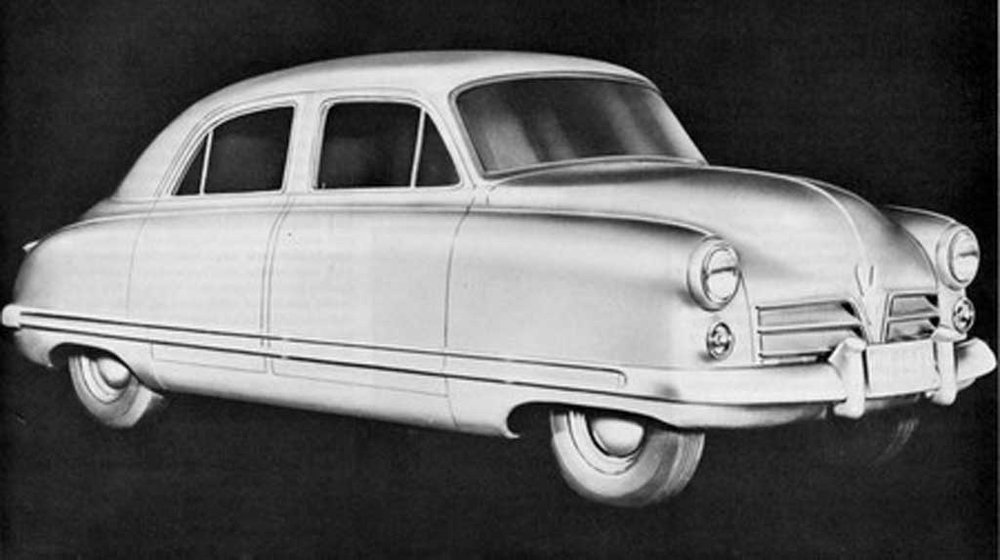
This is a short post because I could find only three images of the proposed General Motors postwar small-car vehicle concept.  Nevertheless, I find it quite interesting because it shows what Harley Earl's styling staff was thinking back in 1945-47.   Some background on the Cadet project is here . Below are those images plus a view of a 1949 Chevrolet, GM's post- World War 2 A-Body redesign. Gallery It's hard to tell if this is an airbrush styling rendering or a heavily retouched photo of a Cadet mockup.  My guess is that it's the latter because a mockup existed, and in those days General Motors staff produced many retouched images.  I further suspect that the grille design was a provisional placeholder for a different production design, though this design would have been satisfactory.  Interesting that the grille of the 1953 Studebaker line also has a V'd segment splitter and a single central horizontal bar. Here is a 1949 Chevrolet four-door notchback sedan. ...

2018 Chevrolet Equinox: Professional, but Not Exciting

Image
Crossover Sport-Utility (SUV) vehicles are very popular here in America and that popularity seems to be growing in Europe and elsewhere.  That class of vehicles has been marketed long enough that many manufacturers are now producing third or even fourth (or more) generation SUVs.  As time passes and experience grows, car makers are getting better at packaging and other aspects of SUV design. Styling remains something of a problem thanks to boxy configurations of what amounts to a tall, often short station wagon body.   Aerodynamic considerations add to styling constraints. The subject of this post is the Chevrolet Equinox , the latest version introduced for 2018. Its styling is what I'd call professional: pleasing with no glaring flaws.  Better yet, it isn't as over-decorated as many Japanese models are.  On the other hand, its styling isn't distinctive -- perhaps a result of having been passed through the sort of design clinic process that Bob Lutz famously cr...

Maybe Not All 1942 Chevrolets Had GM's A-Bodies

Image
During the 1940s and 1950s General Motors used three body platforms.  In those days before the American auto industry began the proliferation into compact, subcompact, SUV and other body types, those cars were all what can be termed "standard-size" though they did vary in wheelbase, numbers and shapes of windows, and other distinguishing details.  GM labeled these bodies A, B and C, and they roughly corresponded to the corporation's brand hierarchy progression of Chevrolet, Pontiac, Oldsmobile, Buick and Cadillac. (I presented a Special-Interest Autos magazine article dealing with B and C body variations here that's well worth reading for background on what GM was doing body-wise.) The A Body was the entry-level one, never found on Buicks or Cadillacs. According to this Wikipedia entry, "Starting in 1936 through 1958, GM used four different designations for various bodyshells/platforms with the A-body for Chevrolet, most Pontiacs, and the Oldsmobile Series F a...